


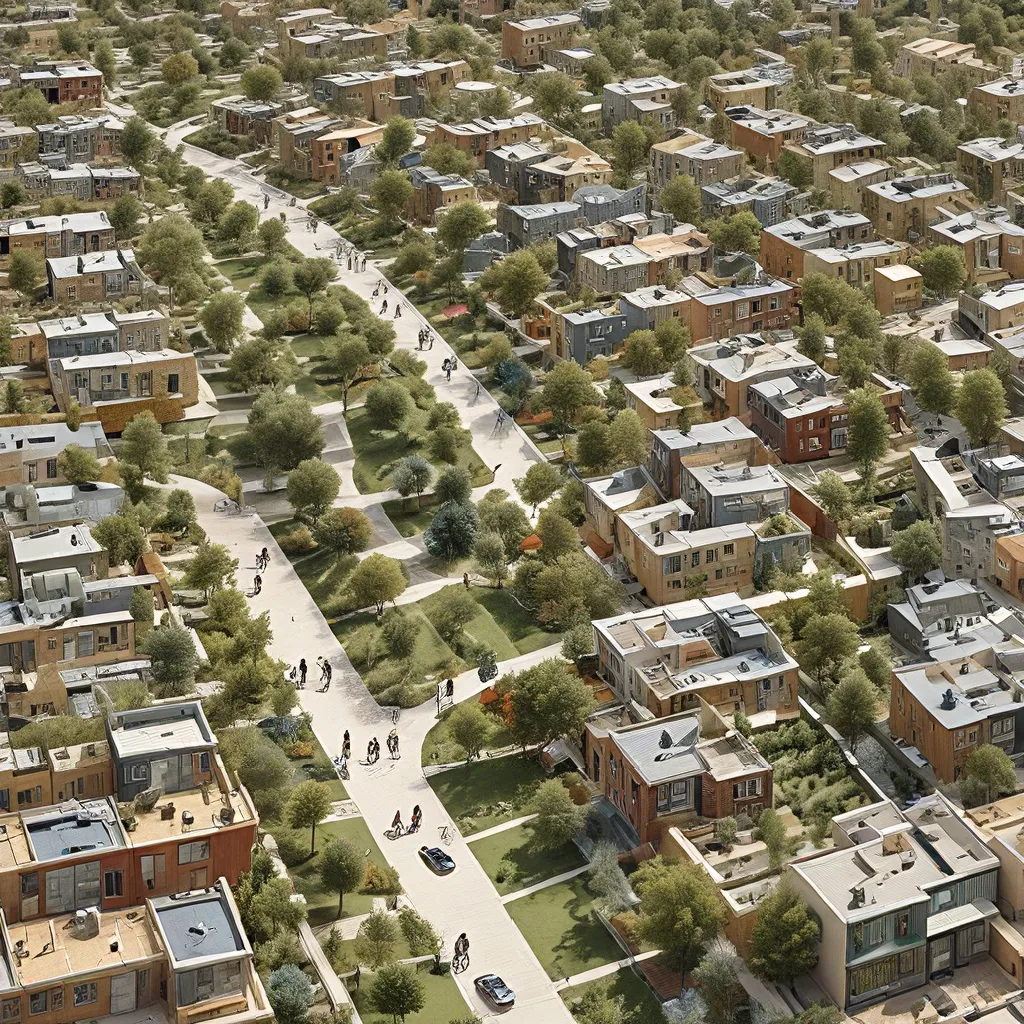
Rethinking the American Dream
As a lifelong resident of this bustling city, I’ve seen the landscape change dramatically over the years. What was once a vibrant, diverse community has slowly transformed into a playground for the wealthy, pricing out the very people who gave this place its character. It’s a story all too familiar across the United States – the American Dream of homeownership slipping further and further out of reach for the average person.
But what if I told you that there’s a way to reclaim that dream, to create neighborhoods where people of all backgrounds can thrive? It’s not just a pipe dream – it’s a vision being brought to life by a growing movement of architects, urban planners, and housing advocates who are redefining what it means to live the good life.
Welcome to the world of affordable utopia – where sustainable, inclusive design isn’t just a lofty goal, but a tangible reality that’s transforming communities across the country.
Breaking Down the Barriers
One of the key challenges we face in creating truly affordable and equitable housing is overcoming the legacy of exclusionary policies and practices that have shaped our built environment. As Antje Steinmuller, chair of the undergraduate program in architecture at the California College of the Arts (CCA), explains, “Exclusionary practices from redlining to single-family zoning and the commodification of land have had lasting effects on patterns of property ownership and residential settlement in the US.”
These systemic inequities have resulted in a stark divide, with marginalized communities often concentrated in areas that are the most vulnerable to the impacts of climate change and environmental degradation. Take the example of New Orleans’ Lower Ninth Ward, a predominantly African American neighborhood that was devastated by Hurricane Katrina due to insufficient levee protection.
But architects and designers are rising to the challenge, using their skills as agents of change to tackle these interrelated issues of environmental and social justice. Through initiatives like the Urban Works Agency research lab at CCA, they’re exploring innovative approaches to property ownership, resource distribution, and urban planning that can help rewrite the script on who gets to live where and how.
Rethinking the Home, Rethinking Community
At the heart of this movement is a fundamental rethinking of the very concept of “home” – moving beyond the traditional single-family house model that has dominated American suburbs and cities for decades. As Brian Price, chair of the graduate program in architecture at CCA, points out, the reality is that the nuclear family unit is no longer the predominant household structure in the US. Instead, we’re seeing a growing diversity of living arrangements, from multigenerational households to single-parent families to unrelated roommates.
So, how can we design homes and neighborhoods that cater to this evolving landscape? One promising approach is the concept of “co-housing” – communities built around shared amenities and collective spaces that foster a sense of belonging and mutual support. As Amy Campos, chair of the interior design program at CCA, explains, “Restructuring housing can restructure social interactions and create community.”
Rather than each family having their own kitchen, living room, and other private spaces, co-housing models distribute these resources across multiple households, reducing individual costs while also encouraging collaboration and social connection. And it’s not just about the physical layout – these communities are designed to be inclusive and accessible, with universal design principles woven into everything from the furniture to the floor plans.
Affordable Utopia in Action
One inspiring example of this approach in action is the Estuary Commons project proposed by CCA’s Urban Works Agency for the Resilient by Design Bay Area Challenge. In partnership with local community groups, the team developed a plan to protect the San Leandro Bay shoreline from rising sea levels while also addressing the issue of affordable housing.
Their vision included innovative design solutions like tunneling a major freeway and building floating neighborhoods on pontoons – not only safeguarding the community from flooding, but also stitching together the patchwork urban fabric and providing a network of parks and shared spaces. Crucially, the project incorporated a focus on collective ownership and resource management, ensuring that the benefits would be equitably distributed rather than accruing solely to private landowners.
And it’s not just about the big, bold ideas – even on a smaller scale, architects and interior designers are finding ways to make a meaningful difference. Take the example of a recent CCA student project that imagined a residence for a household comprising four unrelated senior citizens and the teenagers they were each fostering. By designing the housing unit to bring these diverse residents together, both vertically (with each family unit of one adult and one teen) and horizontally (connecting the adults and the teens), the students created a powerful model for rethinking how residential design can improve social equity.
Toward a More Inclusive Future
As I reflect on the transformative work being done in the field of affordable, sustainable, and inclusive design, I can’t help but feel a sense of cautious optimism. It’s clear that the status quo is no longer tenable – the housing crisis, climate change, and deepening social divisions have made that abundantly clear. But the solutions are out there, being pioneered by a new generation of designers and thinkers who are determined to create a better, more equitable future.
At the heart of this movement is a fundamental belief that the built environment is not just a backdrop for our lives, but a powerful tool for shaping the kind of society we want to live in. Whether it’s reimagining the way we design our homes, our neighborhoods, or our entire urban landscapes, these trailblazers are proving that it’s possible to create affordable utopias – places where everyone, regardless of their background or circumstance, can thrive.
Of course, the road ahead won’t be easy. There will be pushback from entrenched interests, logistical challenges to overcome, and deep-seated biases to confront. But as I look at the work being done by the teams at CCA and the growing network of affordable housing advocates across the country, I can’t help but feel a sense of hope. Because if we can harness the power of design to create more sustainable, inclusive, and equitable communities, then maybe – just maybe – we can reclaim the true promise of the American Dream.
So, what are you waiting for? Join us in building the affordable utopia of tomorrow, one neighborhood at a time. Visit https://www.hacc-housing.org/ to learn more about the work we’re doing and how you can get involved.
Exploring the Possibilities of Affordable Utopia
As I delve deeper into the world of affordable, sustainable, and inclusive design, I can’t help but be inspired by the sheer breadth of possibilities that are emerging. From cutting-edge architectural solutions to innovative approaches to community planning, the vision of an “affordable utopia” is taking shape in ways that challenge our traditional notions of what’s possible.
One particularly intriguing concept that’s been gaining traction is the idea of “micro-housing” – the notion of fitting all the essential elements of a traditional single-family home into a much smaller footprint. As Brian Price, chair of the graduate program in architecture at CCA, points out, this strategy can help address the pressing issue of affordable housing, especially in high-cost markets like California where the median home price is expected to reach over $800,000 in 2022.
But the CCA team isn’t content to simply replicate the conventional house in miniature. Instead, they’re exploring more radical alternatives that move beyond the confines of individual ownership and private space. As Antje Steinmuller, co-director of the Urban Works Agency, explains, the guiding hypothesis is whether “designing dwellings with collective spaces can make housing more affordable as well as more fair.”
This concept borrows from the sharing economy, imagining a future where certain spaces – like commercial kitchens, community workshops, or recreational amenities – are shared across multiple households, reducing the individual cost while also fostering a greater sense of connection and collaboration. It’s a bold vision, but one that’s already being put into practice in innovative projects like the CCA student’s design for a group of immigrant women launching food-truck businesses.
Of course, the path to this affordable utopia isn’t without its challenges. As Amy Campos, chair of the interior design program at CCA, notes, “Housing in our cities and suburbs has been designed around the traditional nuclear family – a stay-at-home mom, a dad who works outside the home, and multiple children – but that family unit is no longer the only or even the predominant model in the US.”
Overcoming these entrenched norms and biases will require a fundamental rethinking of how we approach the design and development of our built environment. But the teams at CCA and other leading institutions are up to the task, tapping into a wellspring of creativity and innovation to chart a new course toward a more inclusive and equitable future.
Putting People First
At the heart of this affordable utopia movement is a fundamental shift in perspective – one that places the needs and experiences of the people at the center of the design process. Rather than starting with preconceived notions of what a “home” or a “community” should look like, these trailblazers are taking the time to deeply understand the diverse lived realities of the individuals and families they’re designing for.
As Amy Campos explains, “As designers we always start with understanding communities as they are. It informs everything we do.” This means engaging directly with marginalized groups, learning about the unique challenges they face, and then using that knowledge to inform the design process.
One powerful example of this approach in action is the CCA student project that imagined a residence for a household comprising four unrelated senior citizens and the teenagers they were each fostering. By centering the needs and experiences of these specific residents, the students were able to create a housing model that not only addressed their practical requirements, but also fostered a sense of intergenerational connection and community.
This people-centric ethos extends beyond the residential realm, informing the way architects and designers are rethinking public spaces and amenities as well. The Stalled project, for instance, proposes abolishing binary single-sex restrooms in favor of a more inclusive, universal design that better serves the needs of gender nonconforming individuals, families, and those with disabilities.
By putting the lived experiences of diverse users at the forefront, these designers are creating spaces and structures that are not just aesthetically pleasing, but actively contribute to the well-being and empowerment of the communities they serve. It’s a powerful reminder that the built environment isn’t just a backdrop for our lives – it’s a tool for shaping the kind of society we want to live in.
Toward a More Equitable Future
As I reflect on the transformative work being done in the field of affordable, sustainable, and inclusive design, I can’t help but feel a renewed sense of hope and possibility. The teams at CCA and other leading institutions are proving that it’s possible to create “affordable utopias” – places where everyone, regardless of their background or circumstances, can thrive.
Whether it’s through innovative housing models, thoughtful community planning, or the application of universal design principles, these trailblazers are rewriting the script on what’s possible. And by centering the needs and experiences of marginalized communities, they’re ensuring that the benefits of these interventions are equitably distributed, rather than accruing solely to the privileged few.
Of course, the road ahead won’t be easy. There will be entrenched interests to confront, logistical challenges to overcome, and deep-seated biases to address. But as I look at the determination and creativity of the teams at CCA and the growing network of affordable housing advocates across the country, I can’t help but feel a sense of optimism.
Because if we can harness the power of design to create more sustainable, inclusive, and equitable communities, then maybe – just maybe – we can reclaim the true promise of the American Dream. Not as a fantasy of individual wealth and homeownership, but as a collective vision of a society where everyone has the opportunity to live with dignity, security, and a sense of belonging.
So, what are you waiting for? Join us in building the affordable utopia of tomorrow, one neighborhood at a time. Visit https://www.hacc-housing.org/ to learn more about the work we’re doing and how you can get involved. Together, we can create a future where the built environment isn’t just a reflection of our divisions, but a testament to our shared humanity.